

Most people think building software requires knowing how to code. That was true a year ago. It is not true anymore.
Claude Code is Anthropic’s AI system that writes, runs, and debugs code directly on your computer. You describe what you want in plain English. Claude figures out the code. You get a working tool to do almost any manual task that you’re doing in your day-to-day work.
I have been using it to build agents for my own business, and the results have surprised me in ways I did not expect. Some things worked immediately. Some things took five iterations. This is an honest account of both.
What actually is an agent, and why is it different from chatting with ChatGPT?
A regular AI conversation is like asking a smart friend for advice. You ask a question. They answer. Done.
An agent is different. An agent takes a goal, breaks it down into steps, uses tools to complete those steps, and keeps going until the job is finished. It does not just answer questions. It does things.
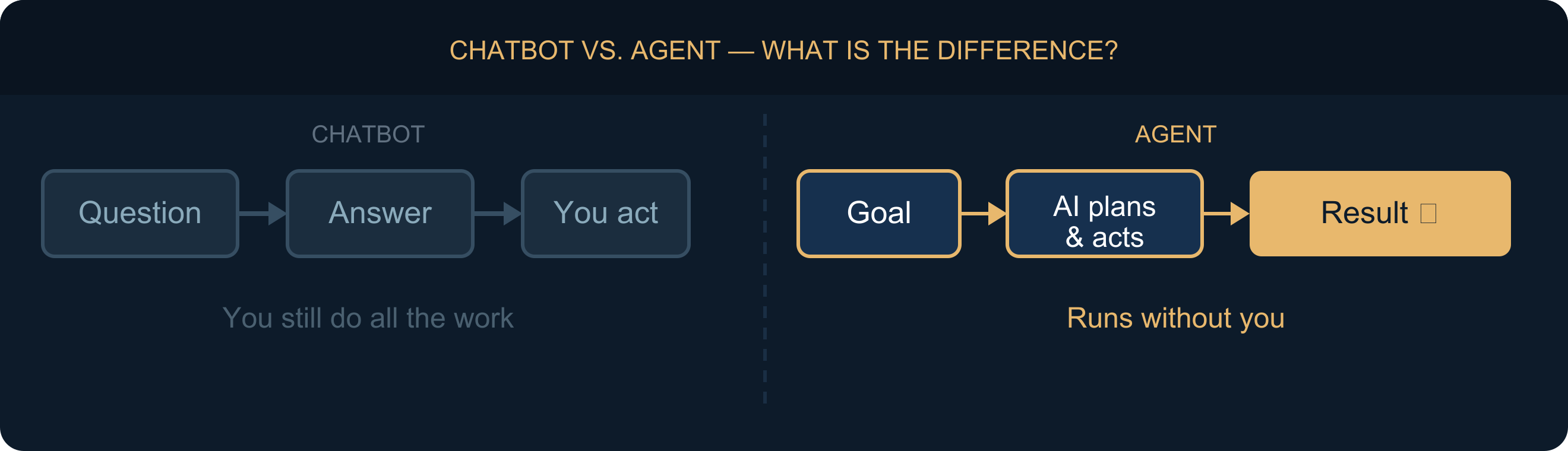
Think of it this way: asking Claude “who should I follow up with this week?” gets you advice. An agent actually searches your inbox, finds past contacts, groups them by topic, and hands you a prioritized list. That is the difference. Advice versus action.
Agents can browse the web, read and write files on your computer, pull data from external services, send emails, and chain all of those steps together without you touching anything after the first setup.
What can agents do for people in the energy industry?
The energy industry runs on data, documents, and repetitive processes. That is exactly where agents shine.
A load forecasting agent could pull weather data, historical usage patterns, and grid demand numbers every morning and produce a plain-English summary for your operations team. No spreadsheet wrangling. No manual data pulls.
A regulatory filing monitor is one of the most valuable builds I can imagine for energy companies. FERC (Federal Energy Regulatory Commission) governs wholesale electricity markets, natural gas pipelines, and hydropower licensing. NERC (North American Electric Reliability Corporation) issues reliability standards, violation notices, and enforcement actions. State PUCs handle rate cases and tariff filings. ISO and RTO filings from grid operators like PJM, MISO, CAISO, and ERCOT contain market rule changes that affect dispatch and pricing. EPA rulemakings affect emissions reporting and permitting for new generation. An agent that monitors all five simultaneously, filters by keywords relevant to your business, and surfaces only what matters is worth a significant amount of someone’s time each week.
An RFP comparison agent could scan incoming vendor proposals, extract the key specs and pricing from each document, and produce a comparison table automatically. What used to take a junior analyst two days takes the agent twenty minutes.
None of these require a full-time developer. They require knowing what problem you want to solve, and maybe an hour or two of back-and-forth with an LLM.
What have I built, and what actually worked?
I want to share my actual experience here, because most “here’s what AI can do” posts skip the failures.
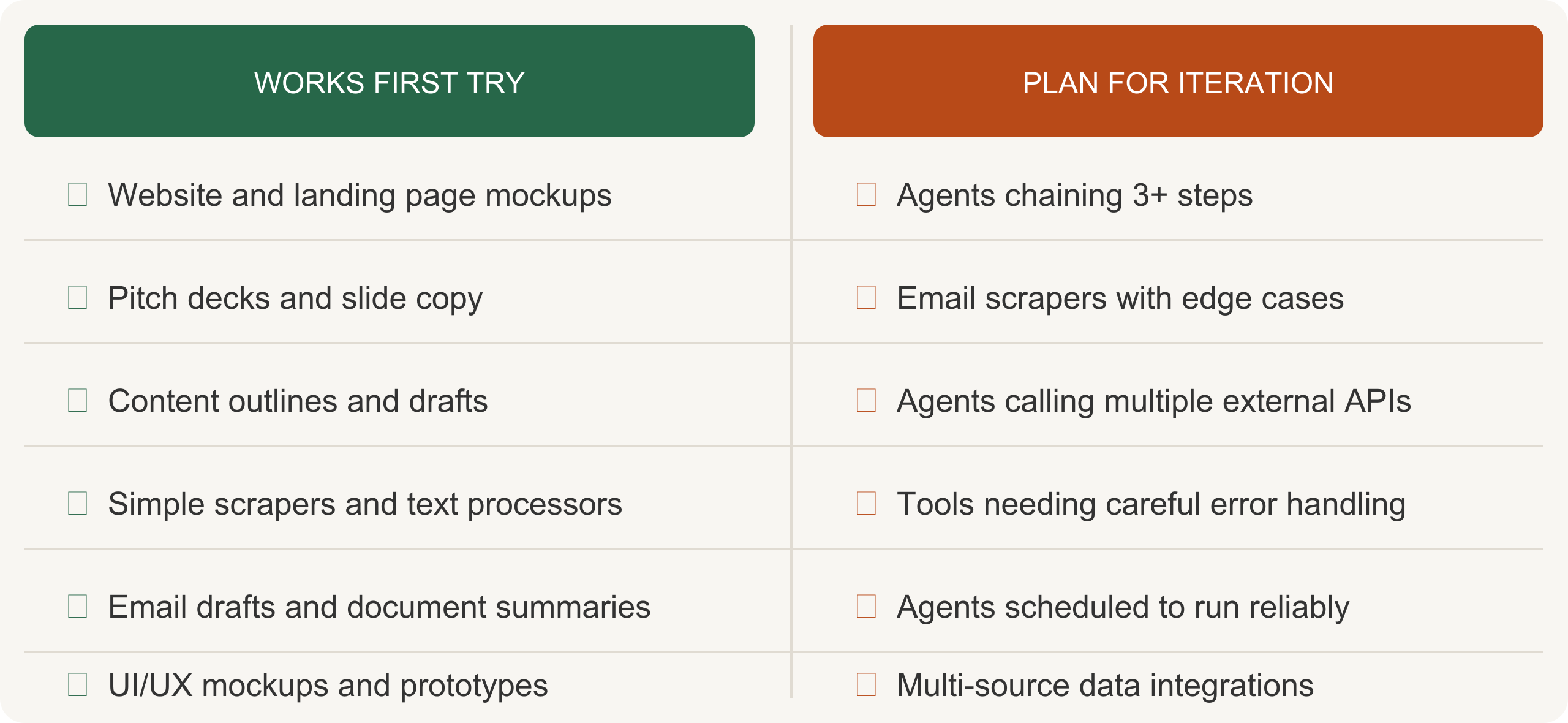
SEO and ranking monitor. Watches my website’s search ranking and surfaces content ideas based on keywords I am not ranking for. Drafts content outlines automatically. Took two sessions to get right. Saves several hours every week now.
Pitch deck and website creator. I describe the company, audience, and message. Claude generates the full deck structure, the slide copy, and a matching website mockup with layout and design. This one worked on the first try. UI/UX and design-focused tasks are where Claude is genuinely one-shot capable right now.
Email history scraper. Scraped my entire email history, found contacts I had not followed up with in months, and grouped them by keyword. Clusters like “grid storage” or “data center development” showed up immediately. Runs every Sunday and gets me a prioritized outreach list every Monday morning. Took five iterations to handle all the edge cases.
Complex agents that chain multiple steps together rarely work perfectly on the first build. The email agent worked, but it took four or five conversations with Claude to handle edge cases: duplicate contacts, unusual email formatting, contacts with no clear topic keyword. That is just the reality of software. Even experienced developers spend most of their time debugging, not writing new code. The difference now is that you do not need to understand the code to fix it. You describe what broke and Claude fixes it.
How do you actually build one from scratch?
Here is the exact process I use. It works for complete beginners.
Go to Claude, ChatGPT, or any LLM and describe the problem in plain English. I use Claude personally, but any capable LLM works for this. Do not think about code yet. Write out exactly what you want to happen. “I want something that looks at my inbox every Monday, finds emails from people I have not replied to in 90 days, and makes a list grouped by what we were talking about.” The more specific you are, the better the result.
Ask whether it can build it and what the best approach would be. Paste your description and ask: “Is this something you can help me build as an agent? What would be the best approach?” Claude will tell you what is realistic, what tools it would use, and whether there is a simpler way to get the same result.
Ask for extremely detailed step-by-step instructions. Tell Claude: “Give me every single step, including how to install anything I need, how to set up any accounts or API keys, and how to run the code. Assume I have never done this before.” Claude will write instructions detailed enough that you do not need to figure anything out yourself.
Follow the instructions and keep the conversation open. Things will break. When they do, copy the error message and paste it back to Claude. Say: “This happened when I ran step 4. What do I do?” Claude will diagnose and fix it. You do not need to understand why it broke.
Iterate one feature at a time. After the basic version works, ask Claude to add improvements one at a time. Add one thing, test it, then add the next. Adding five features at once is how you end up with something broken in five different ways at once.
That is the whole process.
When a general-purpose agent is not the right tool
Claude and ChatGPT are excellent at text, research, email, and document workflows. But some tasks in the power industry require models trained specifically on engineering data, domain conventions, or industrial signal patterns that generic LLMs were never built for.
Dirac generates detailed, animated work instructions automatically from CAD files for complex mechanical assemblies. What used to take twelve hours of manual authoring now takes ninety minutes. Anduril selected Dirac as its core manufacturing documentation platform in January 2026 and reported an 87.5% reduction in authoring time.
SparkCognition builds AI trained specifically on SCADA data and sensor patterns from industrial energy equipment: wind turbines, power generation assets, oil and gas facilities. Their predictive maintenance system identifies equipment failures a median of 37 days in advance with over 90% confidence and no false positives. In one deployment on a fleet of new turbines, it identified a manufacturing defect that would have caused catastrophic damage to a $100 million asset months before traditional monitoring would have caught it.
OpenDrawing generates bills of materials automatically from electrical single-line diagrams. Engineers upload a drawing and the system extracts every component and quantity without manual data entry. It is built specifically for the symbol libraries and tagging conventions used in electrical construction drawings, which a general LLM cannot interpret reliably.
AutoGrid, now part of Schneider Electric’s software portfolio, manages distributed energy resources in real time using AI trained specifically on grid signal patterns and DER (distributed energy resource) behavior data. It currently manages over 5,000 MW of distributed energy resources across more than 100 utility and industrial partners. A general-purpose agent can summarize a DER report. AutoGrid is making real-time dispatch decisions at grid scale.
When does it make sense to use a purpose-built platform instead of building your own agent?
When the task requires a model trained on specific domain data: engineering drawings, industrial sensor streams, power market signals, or equipment failure patterns that general LLMs have no reliable grounding in.
When your organization requires on-premises deployment. Cloud-based LLM APIs are not always acceptable in regulated environments, for NERC CIP (Critical Infrastructure Protection) compliance, or where data sovereignty is a hard requirement.
When you need enterprise-wide deployment with SSO, role-based access controls, audit logs, and compliance certifications. Building your own agent gets one person a useful tool. A purpose-built platform gets your whole organization a vetted, supported system.
When accuracy needs to be mission-critical rather than “good enough.” A regulatory filing monitor built on Claude is genuinely useful. A platform certified for NERC compliance tracking is a different category of reliability.
When you need deep integration with existing enterprise systems like SAP, OSIsoft PI historian, or SCADA platforms that require validated data pipelines and purpose-built connectors.
Building your own agents and using purpose-built platforms are not competing approaches. Most energy teams will end up doing both. Start with one problem you deal with every week. Ask Claude if it can help. See what happens.
Good luck this week.
Will
Sources
AnthropicAI-Driven BOM Creation from Single Line Diagrams
Production Planning, Automated
Anduril Selects Dirac to Power AI-Driven Work Instructions | PR Newswire
SparkCognition suggests improved methods to maximize turbine health
Wind Power EngineeringAutoGrid
Distributed Energy Resource Management
Schneider Electric to acquire AutoGrid | PV Magazine USA