

When US and Israeli forces launched Operation Epic Fury on February 28, striking thousands of targets across Iran in the opening days, the strikes hit military sites, nuclear facilities, and Iranian energy infrastructure. Iran retaliated across the region. Twelve days into a war neither side has shown signs of ending quickly, the question for the global economy is what happens to the Strait of Hormuz, the 21-mile-wide channel between Iran and Oman through which roughly 20 million barrels of oil per day transit the global economy.
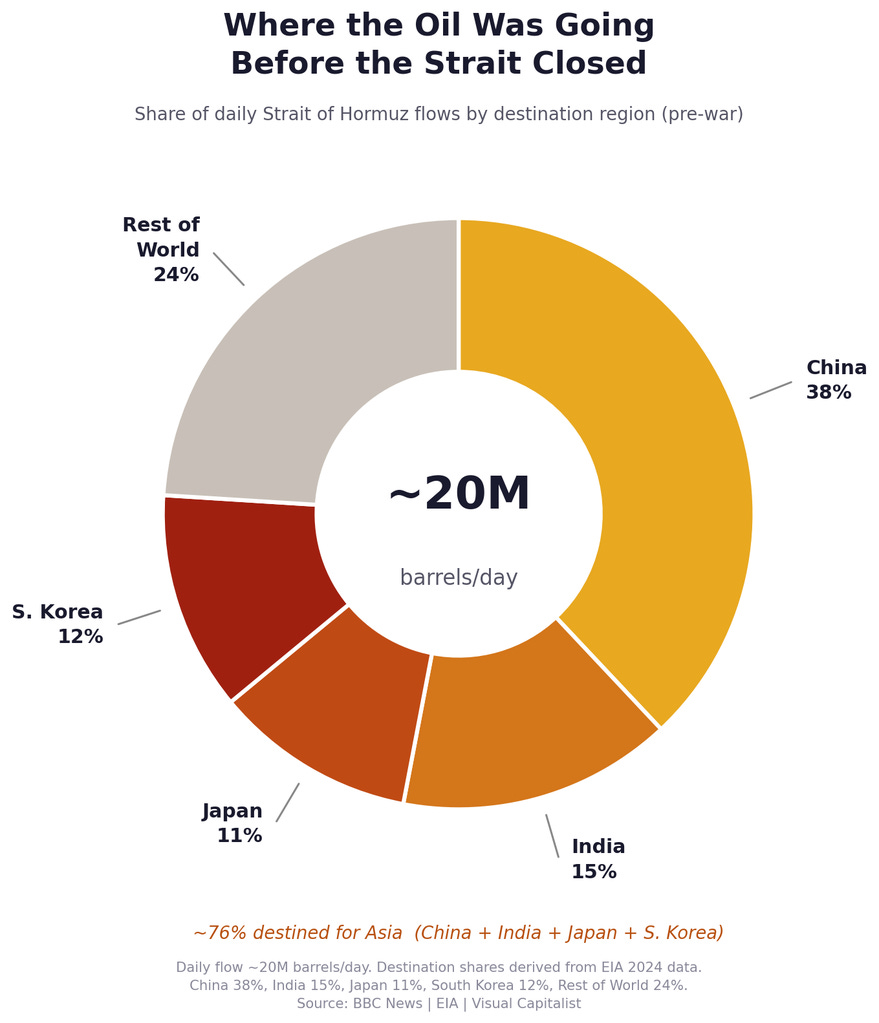
The answer, so far, is that the strait is effectively shut to most commercial traffic. Insurers, shipowners, and crews are unwilling to take the risk. Tanker transits have collapsed, and the downstream effects are cascading through oil markets, natural gas systems, European electricity grids, Asian economies, and hundreds of billions of dollars in Gulf AI investment simultaneously (Bloomberg).
What has the war hit, and what is the impact?
Both sides have struck energy infrastructure. The initial US and Israeli strikes targeted Iranian oil refineries and export terminals alongside military sites, hitting Iran’s own production capacity in the opening hours. Iran’s retaliatory strikes have spread across the region: drone attacks hit QatarEnergy’s LNG production facilities, forcing Qatar to declare force majeure on its gas exports. Force majeure is a legal term for “we cannot perform our contracts due to events outside our control,” and it means buyers around the world are suddenly without supply they were counting on. Qatar supplies 20 percent of global liquefied natural gas (LNG is natural gas that has been chilled to liquid form for transport by ship), and this shutdown happened with essentially no warning (Al Jazeera).
Strikes also hit Amazon Web Services data centers in the UAE and Bahrain, damaging two facilities and hitting a third with debris. This is believed to be the first known deliberate military strike on commercial hyperscale data centers (Yahoo News).
The pattern across all of this is the same: modern conflict does not stay on the battlefield. The same war taking lives in the region is now degrading energy supply and targeting the physical infrastructure of the global AI industry. That is a new reality, and it matters for how you think about what comes next.
Which energy sectors are bleeding fastest?
Oil markets took the first and hardest hit. Brent crude, the global benchmark, has surged more than 57 percent since the war began, jumping from roughly $70 to over $110 per barrel driven almost entirely by supply fear, not actual shortfall. Rystad Energy puts a four-month Hormuz disruption scenario at $135 per barrel (CNBC). The IEA announced a coordinated release of 400 million barrels from member nations’ emergency reserves, which put a ceiling on the panic for now. US gasoline prices have risen roughly 60 cents per gallon since the war began, reaching a national average of around $3.58 (NPR).
LNG markets are arguably worse. Oil has strategic reserves and diversified shipping lanes. LNG does not have the same slack. European LNG benchmark prices (the TTF hub, Europe’s main gas trading point) climbed from €31.9 to €54.3 per megawatt-hour in less than a week. Asian LNG futures jumped 51 percent. European prices jumped 77 percent (CNBC). These are energy-price moves that normally take months or years.
Electricity grids feel it through gas. In most countries, gas-fired power plants are what the grid calls on last, when demand is highest. The final unit of power on the grid in any given hour sets the price for everyone. When gas prices spike 77 percent, electricity prices follow. In Spain, wholesale electricity prices jumped nearly 700 percent in a single week, from roughly €18 to €137 per megawatt-hour (The Olive Press).
Who is most exposed, and who has cushion?
Asia is the most exposed region by far. South Korea maintains a mandatory nine-day minimum LNG stockpile requirement and has announced emergency fuel price caps, the first since the late 1990s, alongside a 100 trillion won ($68 billion) stabilization fund. The country is highly exposed: any sustained disruption to Gulf LNG supply pushes it toward that threshold fast. Government offices across Southeast Asia are cutting work weeks, limiting travel, and imposing alternating driving days (Al Jazeera). Japan and South Korea are scrambling for spot LNG from Australia, Canada, and the US, but alternative cargoes take weeks to arrange.
India is the most vulnerable major economy. The country imports 90 percent of its crude oil, holds roughly 45 days of strategic reserves, and has 9 million citizens working in Gulf countries affected by the conflict. The combination of oil import costs, remittance disruption, and inflation risk is severe (New Lines Institute).
China has the most buffer. Beijing holds an estimated 1.2 billion barrels of strategic crude reserves, roughly 108 days of imports at current refinery levels. More importantly, oil and gas make up a relatively small share of China’s power mix compared with most other Asian economies. China’s aggressive solar and wind buildout, often criticized as overbuilt, turns out to be strategic insulation (CNBC).
Europe is in an uncomfortable middle ground. The EU has diversified its gas supply significantly since Russia invaded Ukraine in 2022, and storage levels are healthier. But the bloc is re-exposed through Qatar, which became a key LNG supplier precisely because it replaced Russian pipeline gas. EU officials are quick to say 2026 is not 2022. What they mean is supply is more diversified. What they cannot say is that pricing will not hurt (Euronews).
What does this mean for the AI industry’s energy buildout?
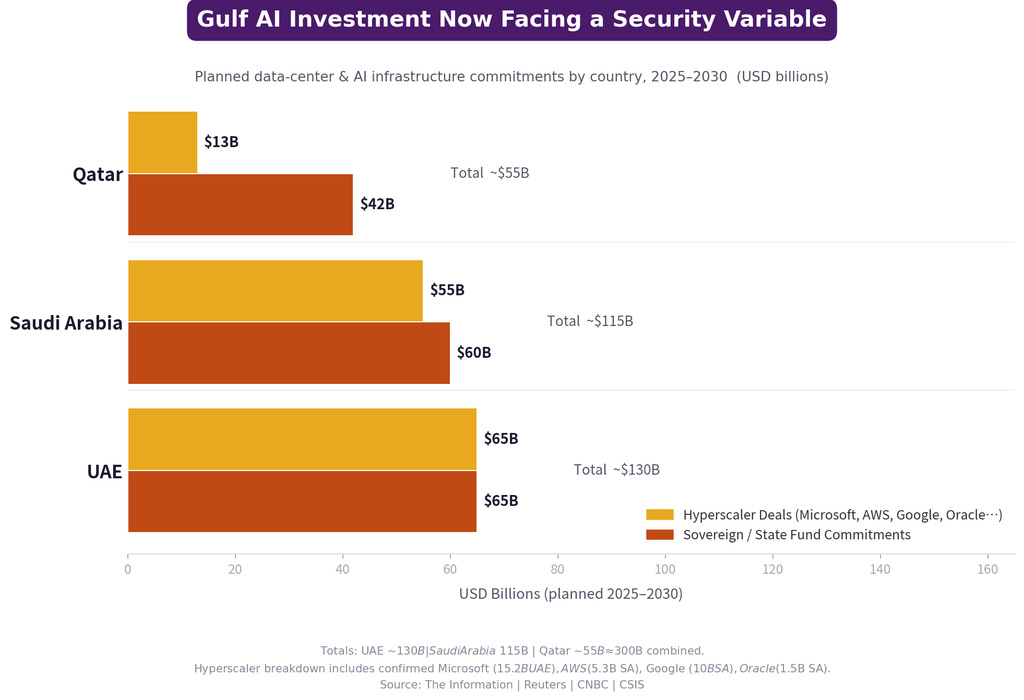
The Gulf was in the middle of a historic AI construction boom when the war started. Saudi Arabia, the UAE, and Qatar collectively committed hundreds of billions of dollars to data centers, chips, and AI infrastructure over the coming years. That buildout now has a targeting problem: the AWS strikes in the UAE demonstrated that data centers are viable military targets, something no hyperscaler had factored into its Gulf infrastructure risk calculus (The Information).
Existing projects will likely continue. Walking away from sunk capital is expensive, and the hyperscalers have long-term government relationships in the region. But the next wave of capacity decisions, the facilities that were still in site-selection and negotiation phases, may quietly shift to locations in Europe, Southeast Asia, or North America. The war has introduced a physical security variable that no lease rate or power deal can easily offset (CNBC).
For the US AI buildout specifically, the pain is indirect but real. Electricity accounts for roughly half of a data center’s operating costs. When energy prices spike globally, the economics of expansion tighten. And the conflict is straining semiconductor supply chains: the Middle East supplies critical inputs including helium and bromine used in chip manufacturing, and logistics disruptions are adding supply-side cost pressure to data center operators at exactly the wrong time (CNBC).
This conflict is twelve days old. The Strait of Hormuz, which has never been fully closed in modern history, is effectively closed now. How long it stays that way will determine whether this is a price shock or a structural reshaping of global energy systems.
Stay safe and have a nice weekend,
Will
Sources
Iran war threatens prolonged impact on energy markets as oil prices rise | Al Jazeera
Iran War: Oil and Gas Supply Squeeze and Strait of Hormuz Disruption, Explained | Bloomberg
Gas prices soar as QatarEnergy halts LNG production after Iran attacks | Al Jazeera
Oil prices surge, but no panic yet, as Iran war continues | NPR
Oil prices: Analysts raise the alarm as crude soars over Iran war | CNBC
EXPLAINER: Impact of Iran war on energy prices and bills in Spain | The Olive Press
Iran war revives spectre of energy crisis in Europe | Euronews
Iran’s attacks on Amazon data centers in UAE, Bahrain signal a new kind of war | Yahoo News
Iran War Imperils $300 Billion in Gulf AI Spending | The Information
How the Iran war could impact hyperscalers’ massive AI buildout in the Middle East | CNBC
How the Iran war and rising energy prices are threatening semiconductor demand | CNBC
The Energy Shock: Impact on Indian, Chinese, and Global Economies | New Lines Institute
Why China can withstand oil’s surge past $100 more easily than other countries | CNBC
Southeast Asia shuts offices, limits travel as oil crisis deepens | Al Jazeera
Will the US benefit from the oil crisis sparked by the war on Iran? | Al Jazeera
What Does the Iran War Mean for Global Energy Markets? | CSIS