

Most people picture a data center as a quiet building. Glass facades, humming servers, precision climate control. The impression is of something contained and sterile.
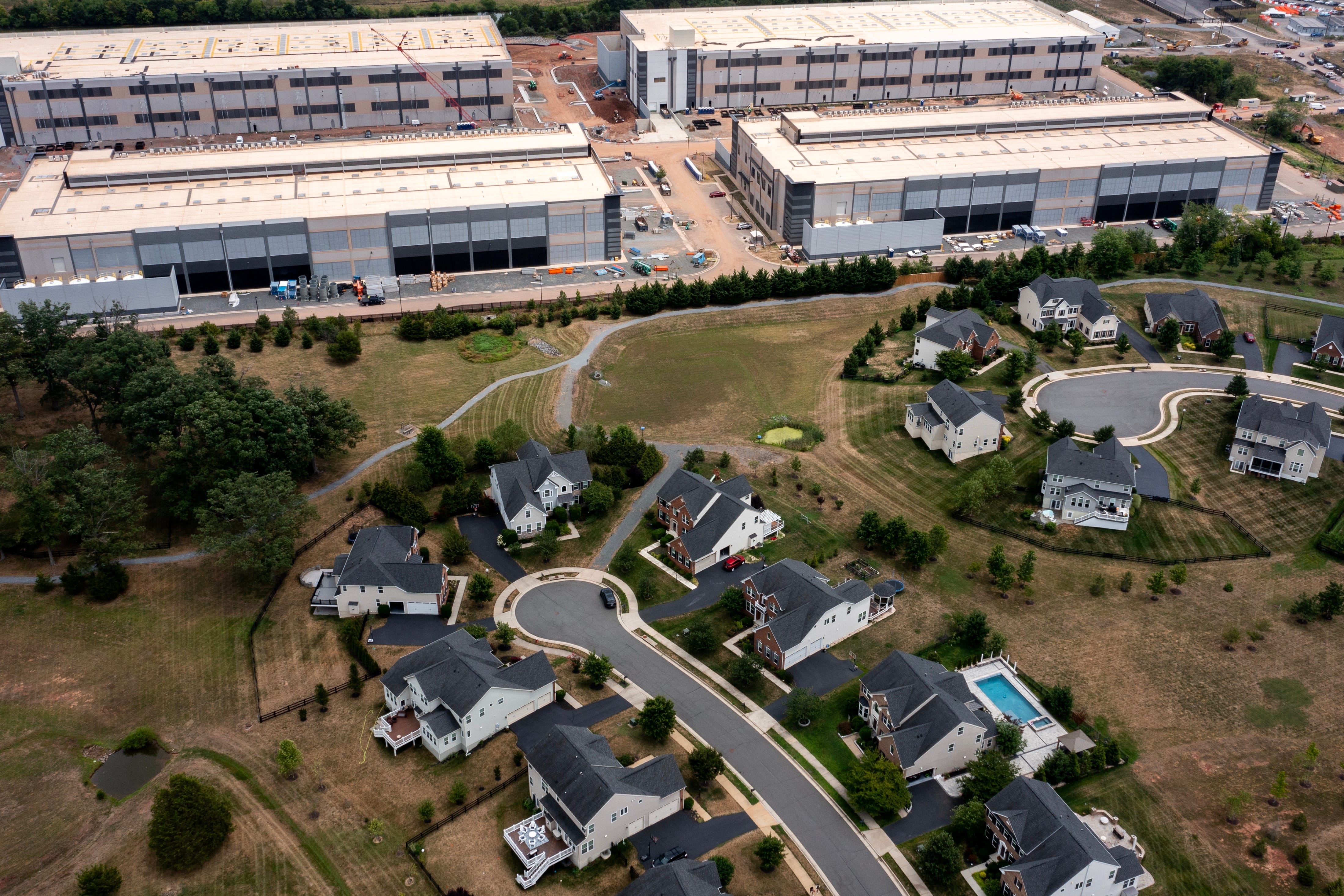
People who live next to one describe something different. A low vibration they feel in their chest at 3am. Headaches that started the month construction finished. Windows that stay closed year-round. Not because of weather, but because of noise. A U.S. News investigation published in April quoted neighbors using the phrase “living in hell.”
The question is whether any of this is improving. New cooling technology is genuinely reducing noise inside and around these buildings. But the biggest source of health complaints near data centers is not the servers. It is the gas turbines.
(NPR)
What are people near data centers experiencing, and what is actually causing it?
Neighbors living near large data center campuses report a consistent set of symptoms: sleep disruption, headaches, dizziness, vertigo, nausea, and ear pain. Some have documented hypertension and panic attacks. The complaints fall into two categories, and they come from two different sources.
The first is air quality. Most large data centers run gas turbines or diesel generators on-site to provide power independently of the grid. These are not emergency backup units that kick on during outages. Many run 24 hours a day, seven days a week, producing the nitrogen oxide and particulate matter emissions the American Cancer Society links to heart disease, lung disease, and cancer. A Virginia Commonwealth University study found that data centers in Northern Virginia, which has the highest concentration of data centers anywhere in the world, produce 11% of the region’s total nitrogen oxide emissions and 3% of its particulate matter as point source pollutants. A separate study used EPA modeling to estimate that one Vantage facility alone causes between $53 million and $99 million in annual health damages to surrounding communities (Piedmont Environmental Council).
The second is noise. Cooling systems that keep servers from overheating run continuously and generate two kinds of sound. Audible fan noise from air-cooled facilities reaches 85 to 100 decibels at the source. That is roughly the equivalent of a motorcycle running outside your bedroom window around the clock. Below that is infrasound, sound under 20 hertz that sits below the threshold of human hearing. You cannot hear it. You can feel it. Research published in Frontiers in Behavioral Neuroscience this year found that infrasound elevates cortisol levels and causes nausea and physical discomfort even in people who have no idea they are being exposed (TechRadar).
Most coverage of the data center health problem focuses on the servers. Turbines and generators, running 24/7 to power those servers, are driving most of the air quality harm.
What is infrasound, and why can’t regulators do anything about it?
Infrasound comes from the data center itself, not the power supply next to it. Large HVAC units, cooling towers, and industrial fans produce sub-20 hertz vibrations as a byproduct of continuous operation. The problem for residents trying to get relief is that standard noise meters are not designed to capture frequencies below 20 hertz. When neighbors file complaints, inspectors arrive with equipment that physically cannot detect what is bothering them. The complaint gets dismissed. The hum continues (Tom’s Hardware).
The 2026 Frontiers study is worth flagging here because it tested subjects who had no expectation of being exposed and no auditory awareness of it. Infrasound still elevated their cortisol and triggered aversive responses. The harm does not require the person to know it is happening.
There is no federal measurement standard for sub-audible industrial noise. Until there is, regulators have no baseline to enforce against.
How bad is the turbine problem, and is anyone tracking it?
The turbines exist largely because the grid cannot keep up. Data centers need power now. Interconnection queues at PJM, the nation’s largest grid operator, run five to seven years. So operators build their own generation on-site. They are functioning as power plants. Many operate under air permits that were not designed for continuous industrial generation (Inside Climate News).
Virginia’s regulators have been tracking what happens if this continues to scale. If Northern Virginia’s data center turbines ran at their full permitted capacity, they would account for 49% of the region’s total nitrogen oxide point source emissions. Virginia’s Department of Environmental Quality launched a dedicated air quality monitoring project specifically because of data center density in that corridor. The state is currently weighing whether to expand the conditions under which facilities can run on-site generators (Grist).
The grid problem creates the health problem. That chain matters because grid-tied power, not better turbines, is the only real fix for the air quality side.
Is liquid cooling actually making a dent in the noise?
Liquid cooling addresses the fan noise problem directly. Traditional air-cooled data centers push roughly 10,000 cubic feet of air per minute through server banks, generating about 95 decibels of ambient noise and consuming 25 kilowatts just for fan power. Immersion cooling, where servers are fully submerged in non-conductive fluid, is virtually silent. Direct-to-chip cooling, which pipes liquid directly to processors rather than blasting air across them, eliminates most facility-level fans. Microsoft began fleet-wide deployment of direct-to-chip cooling across Azure campuses in July 2025. Direct-to-chip now holds a 47% share of new data center cooling deployments (Introl).
Most existing data centers were not built for liquid cooling, and retrofitting them is expensive. Liquid cooling is being adopted in new hyperscale builds. The legacy stock already sitting in residential corridors in Virginia, Phoenix, and Chicago’s suburbs will stay air-cooled for years. The technology is improving at the leading edge; the installed base is not.
Liquid cooling also does nothing for the infrasound problem. The sub-audible hum comes from building-level mechanical systems: cooling towers, HVAC units, and large pumps. Swapping server cooling from air to liquid does not eliminate those.
Are regulations actually forcing the industry to change?
Regulations are starting to move, but slowly. Montgomery County, Maryland adopted a 50-decibel noise limit at property lines for data centers, stricter than Maryland’s standard 65-decibel industrial threshold and among the toughest in the country. Chandler, Arizona’s city council voted unanimously against a new data center application in 2025, with noise concerns cited explicitly. More than 200 data center-related bills were introduced in state legislatures in 2025 alone, and moratorium proposals have appeared in 11 states in 2026 (MultiState).
The infrasound gap remains unaddressed at every level of government. No federal standard exists for measuring sub-audible industrial frequencies. Communities cannot file effective complaints for something that available equipment cannot record. Researchers can document the health effects; regulators have no mechanism to act on them.
Fuel cells are a more promising near-term answer to the turbine problem than nuclear or renewables. Goldman Sachs estimates fuel cells could cover 6 to 15 percent of incremental data center power demand, with modular systems deployable in under a year, far faster than grid interconnection. They produce fewer emissions than gas turbines and generate substantially less noise (Goldman Sachs). Adoption is early.
The technology to reduce harm near data centers exists and is improving. Liquid cooling works. Fuel cells are cleaner and quieter than gas turbines. The problem is that adoption moves in years and the buildout is moving in months. For the communities sitting next to today’s infrastructure, they need improvements now.
Have a nice weekend
— Will
Sources
‘Living in Hell’: Data Center Neighbors Grapple With Noise, Air Pollution | U.S. News
Northern Virginia data center air pollution rivals power plant emissions | VCU News
AI data centers face increasing complaints about infrasound | Tom’s Hardware
Data centers are scrambling to power the AI boom with natural gas | Grist
Fuel Cells Could Help Meet the Power Demand from Data Centers | Goldman Sachs
Communities Are Raising Noise Pollution Concerns About Data Centers | EESI