

Did you know that the U.S. built the world’s first small nuclear reactor? It was installed on a submarine in the 1950s. But today, as AI’s power needs explode, it’s Russia and China, not the U.S., that are generating real electricity from modern small modular reactors (SMRs). The Department of Energy wants to change this with a pilot program that they just launched to get three SMRs online within the next 11 months, a remarkable feat if you know how slow nuclear projects typically move. This week’s newsletter breaks down what SMRs are, how we lost our lead, and what we’re doing to catch up.
What is an SMR?
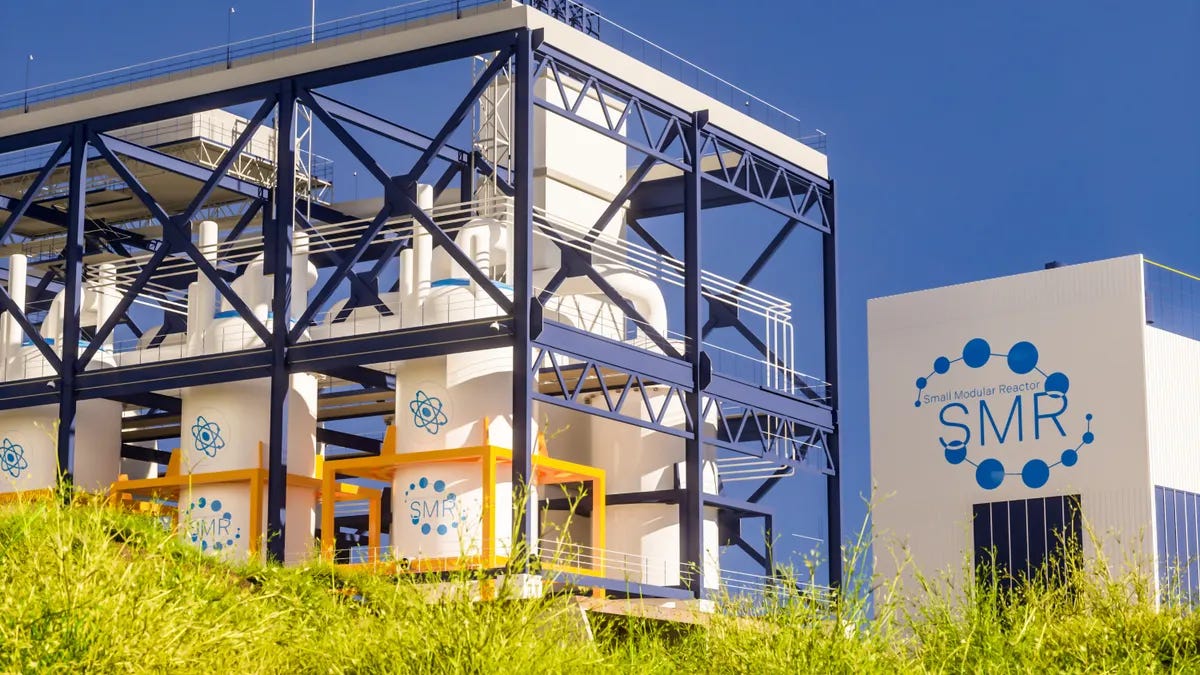
A small modular reactor (SMR) is a type of nuclear reactor that uses fission to generate between 50MW and 300 MW of electricity. That is less than a third of the size of typical large reactors, which can often reach 1,000MW.
SMRs are great because they can be built on assembly lines, shipped to sites on 18-wheelers, and paralleled together to get as much power as you need. They’re safer and faster to deploy than traditional nuclear plants.
These reactors are ideal for data centers because they provide dense, reliable, 24/7 power without taking up much space. Unlike wind and solar, SMRs don’t depend on the weather or massive and expensive battery banks. That’s why they’re suddenly on everyone’s radar as AI pushes energy demand to new highs.
Source: Utility Dive
We invented the tech. But we never deployed it
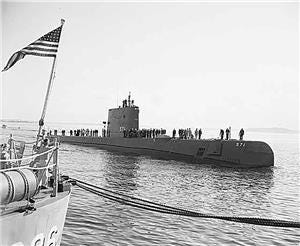
The U.S. built the first small nuclear reactor in 1954 for the USS Nautilus, a nuclear-powered submarine. Over the next two decades, we experimented with grid-connected small reactors like Fermi 1(150MWe) in Michigan and EBR-I(20MWe) in Idaho.
But by the 1980s, the U.S. nuclear industry shifted entirely to massive 1,000+ MW plants. SMRs were set aside, mostly due to cost, regulation, and a preference for economies of scale. No new small reactors were deployed, and the existing ones were eventually shut down.
Source: History Link
Russia and China filled the gap
Russia was the first to put SMR-style reactors on the civilian grid with the Bilibino EGP-6 units in the 1970s. Later, in 2019, they launched Akademik Lomonosov, a floating nuclear barge housing two 35 MWe reactors that now power the remote city of Pevek.
China skipped the legacy phase entirely and went straight to next-gen tech. In 2023, it became the first country to connect a Generation IV SMR to the grid, with its HTR‑PM project: two high-temperature gas reactors that produce 210 MWe(WNN).
Now it’s time for the U.S. to catch up
Earlier this year, there was no expectation that we would see any SMRs installed on American soil before the 2030s. That has changed over the last few months.
On Tuesday, the Department of Energy selected 11 startups, Oklo, Aalo Atomics, Antares Nuclear, Atomic Alchemy, Deep Fission, Last Energy, Natura Resources, Radiant Energy, and Valar Atomics, to participate in a pilot program to try to get three SMRs online by July 4th, 2026 (Barron’s).
In May 2025, President Donald Trump signed an executive order directing the DOE to skip the traditional licensing process used by the Nuclear Regulatory Commission (NRC) for these pilot projects.
It will be extremely difficult for anyone to meet these aggressive timelines, but now that the licensing process is out of the way, it isn’t completely out of the question.
What does this mean for you?
Data center developers: Start evaluating nuclear sites today. If we keep the current pace, SMR projects will be feasible in the U.S. well before 2030.
Utilities and grid operators: Don’t wait for federal funding. Partner with tech companies and SMR vendors now to reduce your risk with this early stage technology.
Power plant EPCs and suppliers: Prepare for a new kind of customer: fast-moving, AI-focused, and willing to pay a premium for reliability.