

Valar Atomics Closes $1 Billion Series B at $6 Billion Valuation
Nuclear startup Valar Atomics raised $1 billion in Series B funding led by Sequoia Capital, valuing the company at $6 billion, with an additional $200 million credit facility (Bloomberg). CEO Isaiah Taylor said the investment will help the company shift from “demonstrating the operability of an integrated reactor system to producing fleets of them en masse” (SiliconANGLE). The Dallas company recently completed its Ward 250 reactor, a 30 MW waterless system that became the first startup-built advanced reactor to achieve criticality and directly power an NVIDIA Blackwell cluster (FinSMEs).
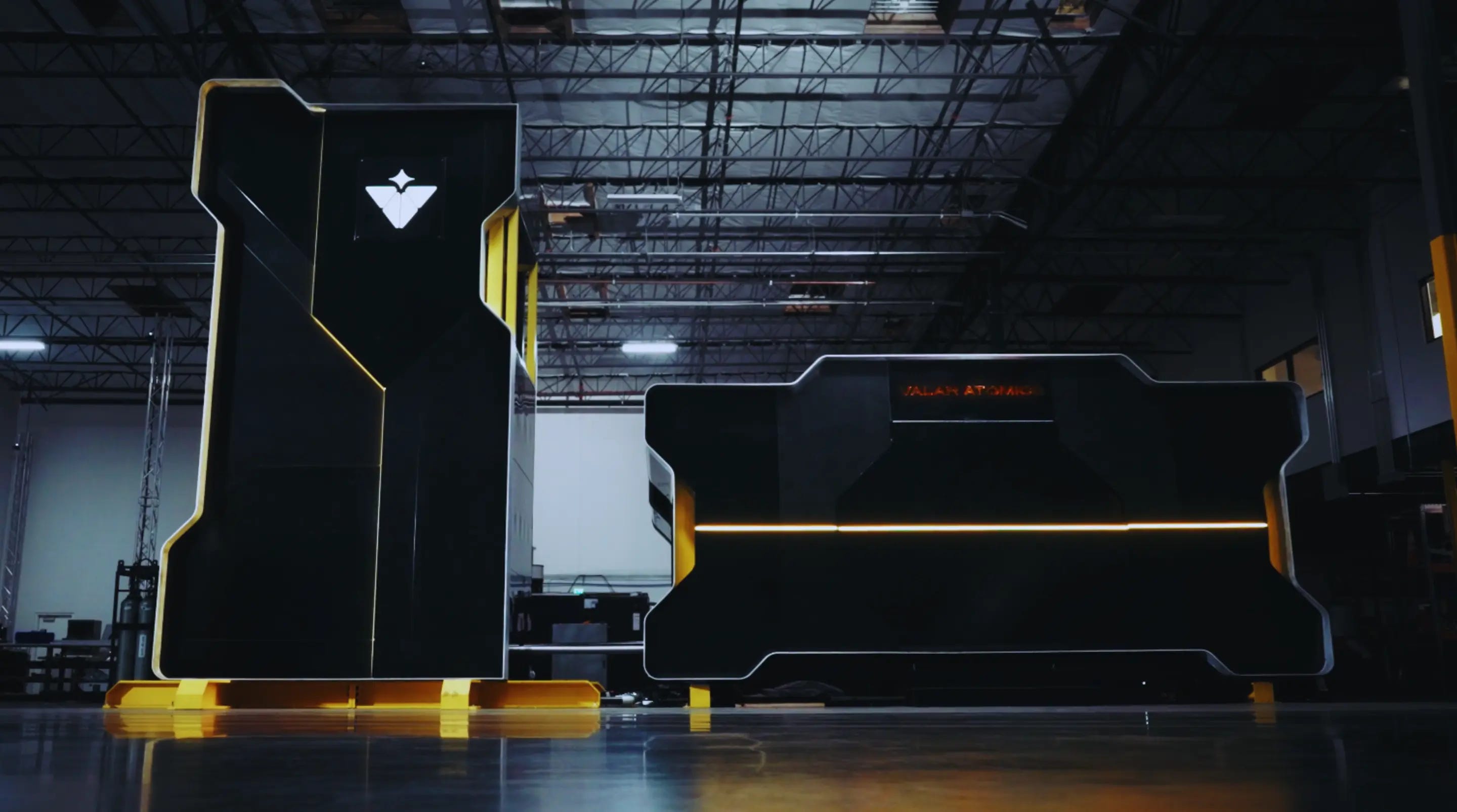
This is the second nuclear microreactor company to close a billion dollar round in two weeks. The speed from criticality demonstration to mass production financing tells you where investor conviction sits right now. AI data centers need firm power, and the capital markets are pricing nuclear as the only scalable answer to 24/7 baseload at gigawatt scale.
Aalo Atomics Hits Criticality on July 4, Fourth Microreactor to Meet DOE Deadline
Aalo Atomics achieved criticality for its Critical Test Reactor at 12:20 a.m. MT on July 4, 2026 at Idaho National Laboratory, meeting President Trump’s goal for companies in the DOE Reactor Pilot Program (Business Wire). Criticality is when a nuclear reactor achieves a self-sustaining chain reaction, the moment fission becomes continuous without external input (DCD). The company went “from breaking ground to a sustained chain reaction in just eight months,” one of the fastest reactor builds in modern American history (POWER Magazine).
The Critical Test Reactor is a full-scale zero-power reactor demonstrating the nuclear components of Aalo’s 10 MWe reactors, which will be deployed in 50 MWe Aalo Pods to power AI data centers (Principal VC). Aalo uses LEU+ fuel, uranium enriched to approximately 8 percent, which uses an existing supply chain rather than high-assay low-enriched uranium, and the company has raised more than $136 million from investors including Valor Equity Partners, NRG Energy, and Hitachi Ventures (TechTimes).
Antora Energy Raises $550 Million for Thermal Battery Deployment
Thermal energy storage company Antora Energy closed $550 million in Series C funding on July 30, co-led by G2 Venture Partners and Eclipse, with participation from Ribbit Capital, Salesforce Ventures, and John Doerr (Yahoo Finance). Antora’s thermal batteries store low-cost electricity as heat in insulated blocks of solid carbon and deliver it around the clock as heat or power (Yahoo Finance). A 5 GWh deployment at a South Dakota ethanol plant, the largest thermal battery project in the world, moved from initial construction to energy delivery in under 12 months (Startup Fortune).
The funding will support deployment of large-scale projects across the US, expand production capacity, and establish a second US manufacturing hub (Energy Storage News). Data centers need energy that works when the sun does not shine and the wind does not blow. Thermal batteries sidestep the lithium supply chain entirely and deliver continuous industrial heat, making them viable for both AI infrastructure and heavy manufacturing.
Nvidia in Talks for $250 Billion Backstop on OpenAI’s 10 GW Ohio Data Center
Nvidia is negotiating a financial guarantee worth approximately $250 billion to support OpenAI’s planned 10-gigawatt data center in southern Ohio being developed by SoftBank’s energy subsidiary (Yahoo Finance). The overall cost could exceed $500 billion including chips, and the first phase is expected to deliver approximately 800 megawatts of capacity by 2028 (Yahoo Finance). A 10-gigawatt facility is 50 to 200 times the size of a large enterprise data center (Enterprise DNA).
Nvidia’s backing would allow SoftBank to raise debt at more favorable terms, making the facility more viable (DCD). The deal structure is notable because it puts a chip maker in the position of underwriting utility-scale infrastructure. OpenAI needs compute. Nvidia needs guaranteed chip buyers. SoftBank needs a credible tenant to secure debt financing. The transaction solves all three problems at once, and it signals that the largest AI buildouts now require sovereign-scale capital structures.
Together AI Raises $800 Million Series C at $8.3 Billion Valuation
Together AI closed an $800 million Series C at an $8.3 billion valuation on July 1, 2026, led by Aramco Ventures, with NVIDIA and General Catalyst joining (Enterprise DNA). The company reported that its annual bookings surpassed $1.15 billion in the last quarter (Yahoo Finance). Together AI runs a cloud platform that lets businesses train and deploy AI on open-source models like Llama, Mistral, and Qwen at significantly lower cost than using proprietary closed systems (Enterprise DNA).
The company secured commitments for over 500 MW of compute capacity to be capitalized independently by new investors to support expected compute growth (Together AI). Aramco Ventures leading a US AI infrastructure round underscores how sovereign capital is flowing into compute infrastructure, particularly infrastructure that does not lock users into closed frontier models.
FERC Issues June Orders Directing Grid Operators to Reform Large Load Interconnection
FERC launched “aggressive targeted action” to speed up large load interconnection following its June 18, 2026 open meeting, issuing tailored orders to each US regional grid operator (American Action Forum). Large loads are sources of electricity demand exceeding 20 megawatts, and developers in some regions now wait as long as seven years to bring new data centers online (CSIS). By roughly August 17, 2026, each operator needs to have either filed revised interconnection tariffs or made the case to FERC that its existing rules already satisfy the order’s goals (Tech Insider).
FERC’s aggressive timelines will likely reshape the AI data center landscape by significantly shortening the multi-year interconnection queue backlog and leading to new retail large-load rate categories in more states (American Action Forum). The August tariff deadline will force every grid operator to put hard numbers on how much headroom they have left before AI data center demand outstrips delivery capacity.
PJM Interconnection Approves Fast-Track Process for Large Generation Projects
FERC approved PJM Interconnection’s Expedited Interconnection Track on June 9, 2026, taking effect July 31, 2026 and running through December 31, 2027 (Certrec). PJM will review up to 10 interconnection requests per year for projects providing at least 250 megawatts of unforced capacity with full site control and a state siting authority commitment (Certrec). Unforced capacity is the amount of power a generator can reliably deliver during peak demand, accounting for expected outages (Certrec).
Interconnection customers in the EIT bear 100 percent of the cost of any network upgrades required to connect their project, a sharp departure from PJM’s standard cluster process which allows cost-sharing among grouped projects (MLQ News). PJM runs the grid for 13 states plus DC, and the fast-track window is designed to bring shovel-ready generation online before the region faces a capacity shortfall.
Lawrence Berkeley Lab Reports Interconnection Queue Declined 10 Percent in 2025
Generator interconnection queues across the US are showing signals of improvement as historical backlogs wane, with 2,061 gigawatts of generation and storage capacity now actively seeking grid interconnection, a 10 percent decrease from 2024 to 2025 (Lawrence Berkeley National Laboratory). The backlog of generator interconnection requests surged in the 2010s and early 2020s, reaching a peak of nearly 2,600 GW active at the end of 2023 (Lawrence Berkeley National Laboratory).
Several grid operators are adopting automation, advanced computing, and AI software resources to speed up interconnection procedures and studies, while MISO, SPP, and PJM have implemented new limited-term fast-track interconnection programs (American Public Power Association). The 10 percent decline is a first step, but process timelines remain long and the queue still represents more capacity than the entire installed US power plant fleet.
Lincoln Electric System Launches 3 MW Zinc Battery for Nebraska Microgrid
Lincoln Electric System celebrated the launch of its first utility-scale battery energy storage system on July 17, a 3-megawatt, four-hour zinc battery system that stores electricity when demand and prices are low (American Public Power Association). The 3-MW/12-MWh zinc-based battery will support the Nebraska state Capitol complex and other critical infrastructure (Utility Dive). Zinc batteries use a different chemistry than lithium-ion, which makes them less prone to catching fire and more suitable for long-duration storage (Utility Dive).
Project partners include WATTMORE, Bridge Renewables, and Eos Energy (American Public Power Association). Utilities are testing non-lithium battery chemistries for applications where duration matters more than instant response. Zinc is abundant, the supply chain is domestic, and the fire risk is negligible. For a microgrid supporting a state capitol, those trade-offs make sense.
Have fun this week,
Will
Sources
Sequoia Leads $1 Billion Investment in Nuclear Startup Valar Atomics | Bloomberg
Valar Atomics Raises $1.2 Billion in Series B and Credit Facility | FinSMEs
Aalo Atomics Achieves Criticality Milestone; Meets Executive Order Goal | Business Wire
Microsoft-backed SMR firm Aalo achieves test reactor criticality as part of DOE program | DCD
Aalo Atomics Brings Its First Reactor to Criticality | Principal VC
Nuclear Microreactor Clears Criticality: Crusoe Plans AI Factory Data Center Test | TechTimes
Nvidia explores $250 billion guarantee for OpenAI’s Ohio data centre project | Yahoo Finance
Nvidia considers $250bn backstop for OpenAI’s planned 10GW Ohio data center - report | DCD
Nvidia Eyes $250B Guarantee for OpenAI’s 10GW Ohio Hub | Enterprise DNA
Together AI Raises $800M to Cut Open-Source AI Costs | Enterprise DNA
Open-source AI firm Together AI secures $800m in Series C | Yahoo Finance
Announcing our $800M Series C to accelerate the shift to open-source AI | Together AI
FERC Data Center Orders Accelerate Grid Connection | American Action Forum
Large Load Reform: How Prepared Are U.S. Grid Operators for the AI Era? | CSIS
US Grids Get 60 Days to Fix AI Data Center Power | Tech Insider
FERC Approves PJM’s Fast-Track Interconnection Process for Large Energy Projects | Certrec
FERC Approves PJM Expedited Interconnection Track for Large Power Projects Through 2027 | MLQ News
30-MW Nebraska microgrid gets a non-lithium battery boost | Utility Dive